Unveiling 7 Fascinating Features of Megalodon Tooth Anatomy
Unveiling Megalodon tooth anatomy provides scientists and fossil collectors with
remarkable Unveiling information about one of the largest predatory sharks ever known. Because
shark Unveiling skeletons are primarily composed of cartilage, complete Megalodon skeletons are
extremely uncommon in the fossil Unveiling record. Teeth, however, mineralize readily and are
found in marine deposits Unveiling around the world.
This makes fossil teeth one of the most important sources of evidence for studying
Megalodon. By Unveiling Megalodon tooth anatomy, researchers can examine
features related to feeding, tooth position, growth, evolutionary relationships, and
adaptation to hunting large marine prey.
The impressive appearance of a Megalodon tooth is only part of its scientific value.
The crown, root, serrations, bourlette, cutting edges, shape, and position within the
jaw all contribute information about how this prehistoric shark functioned.
In this educational guide, we will examine seven fascinating features of
Megalodon tooth anatomy and explain why these structures remain so
important to paleontologists, educators, and fossil collectors.
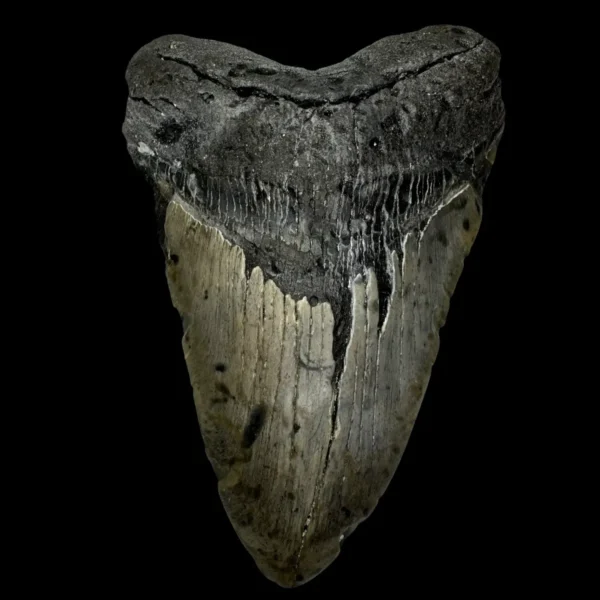
1. Megalodon Tooth Anatomy: The Powerful Crown
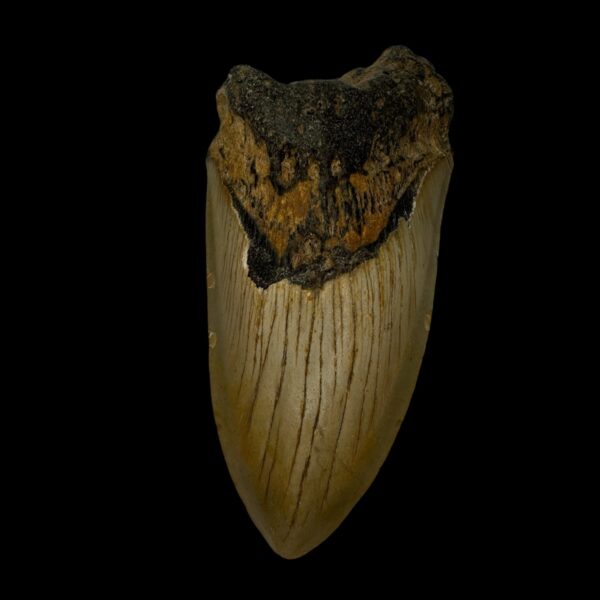
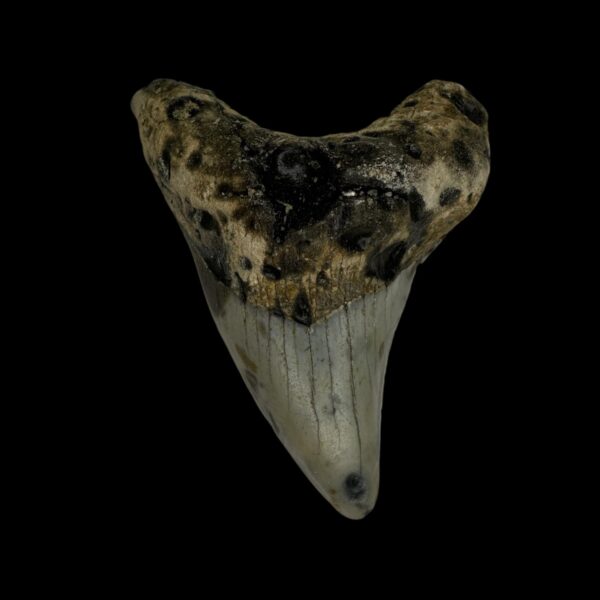
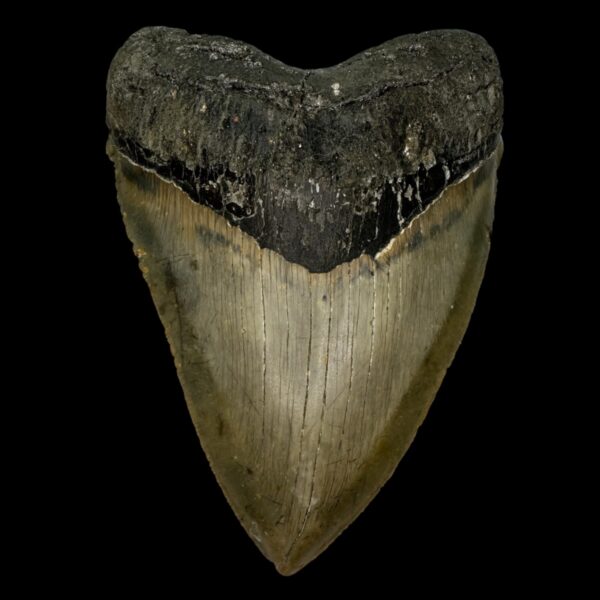
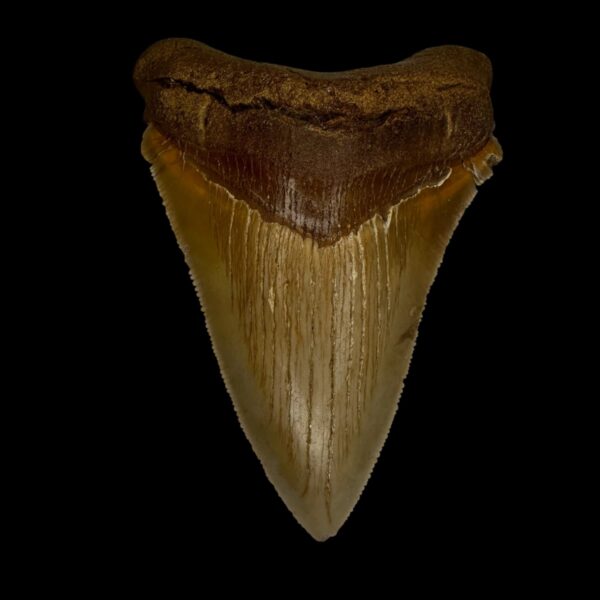
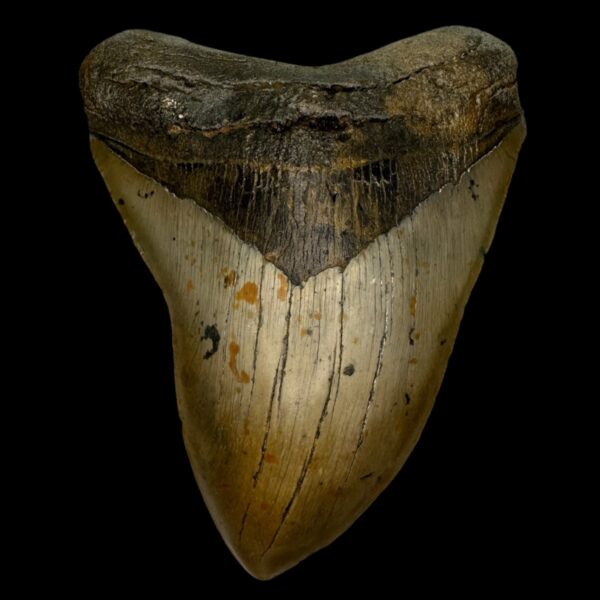
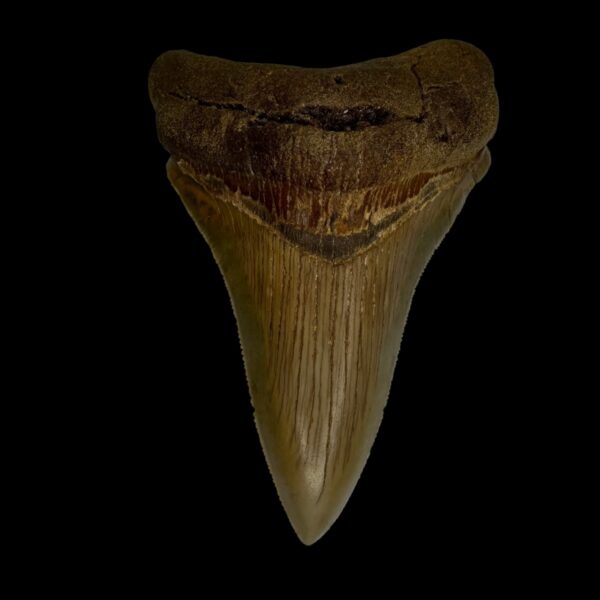
The crown is the most visually recognizable part of
Megalodon tooth anatomy. It is the portion extending above the root and
contains the cutting surfaces that interacted directly with prey.
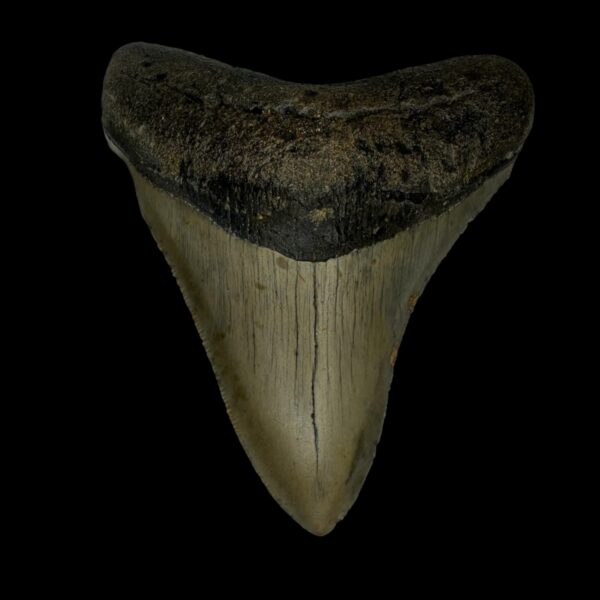
Megalodon crowns are generally broad, triangular, and robust. This morphology differs
from the narrower teeth associated with sharks adapted primarily for capturing smaller
or more streamlined prey.
A broad crown provided a large cutting surface capable of functioning against substantial
marine prey. Fossil evidence indicates that Megalodon occupied ecosystems containing
whales, dolphins, seals, sea turtles, large fish, and other marine animals.
Why the Crown Matters in Megalodon Tooth Anatomy
Paleontologists examine crown width, height, curvature, thickness, and cutting edges when
studying fossil teeth. Differences between teeth can sometimes reflect their original
positions within the shark’s jaw.
Collectors also pay close attention to crown preservation. Natural enamel, intact tips,
minimal erosion, and visible cutting edges can make a specimen particularly attractive.
However, natural wear should not automatically be considered a defect because it forms
part of the fossil’s geological history.
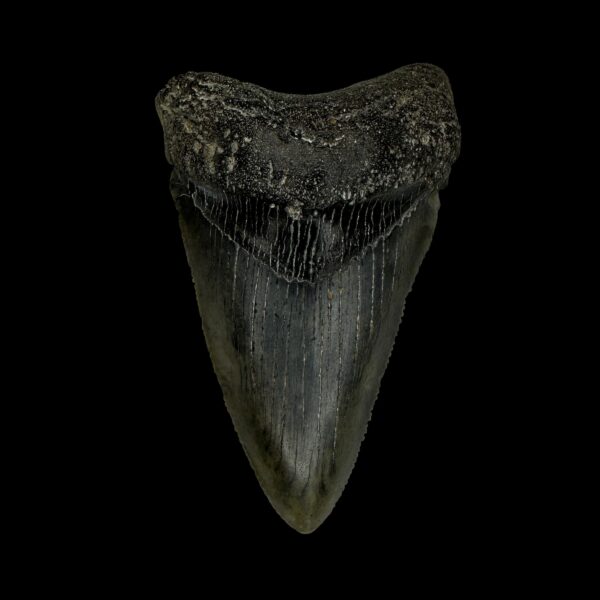
2. Megalodon Tooth Anatomy: The Serrated Cutting Edges
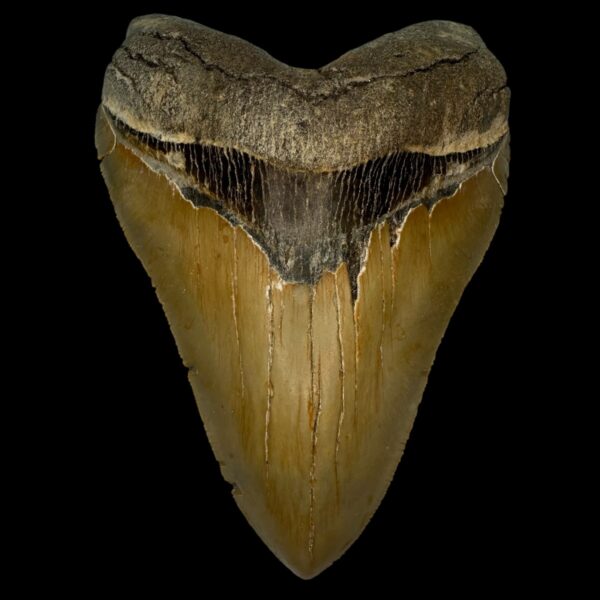
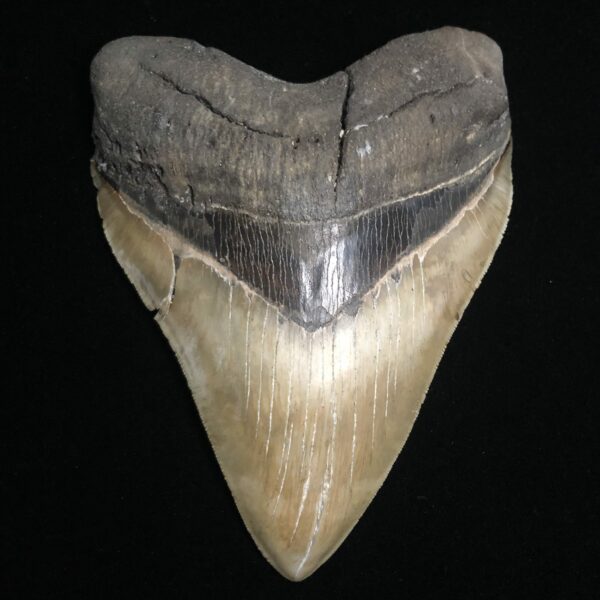
Serrations are among the most distinctive characteristics of
Megalodon tooth anatomy. These small structures occur along the cutting
edges of the crown and create a saw-like margin.
Well-preserved Megalodon teeth can retain numerous individual serrations despite having
spent millions of years buried within marine sediments.
The presence of serrated edges reflects a feeding adaptation suited to cutting through
substantial prey. Similar principles can be observed in several living predatory sharks,
although Megalodon’s enormous teeth operated on a much larger scale.
What Megalodon Serrations Can Reveal
Researchers may examine serration size, spacing, preservation, and distribution when
comparing specimens. Serrations can also help distinguish naturally preserved cutting
edges from surfaces that have been heavily worn or altered.
For collectors, complete serrations are often highly desirable because they preserve
one of the tooth’s most recognizable anatomical characteristics.
Not every authentic Megalodon tooth retains perfect serrations. Ocean movement,
abrasion, geological pressure, and millions of years of burial can naturally reduce
their visibility.
3. Megalodon Tooth Anatomy: The Robust Root Structure
Another fundamental component of Megalodon tooth anatomy is the root.
The root anchored the tooth within the soft tissues of the shark’s jaw while the animal
was alive.
Megalodon roots are typically broad and substantial, creating a strong base beneath the
crown. Their exact shape varies depending on the tooth’s location within the jaw.
Anterior teeth can display different proportions from lateral or posterior teeth.
Studying these differences helps paleontologists reconstruct how multiple teeth were
arranged inside the mouth.
Why Fossil Root Preservation Is Important
The root is often more vulnerable to geological damage than the enamel-covered crown.
Some fossil teeth are discovered with portions of the root missing because of erosion,
pressure, or movement within sediment.
A well-preserved root can therefore provide additional anatomical information and
increase the completeness of a specimen.
Natural cracks, mineral deposits, and erosion on the root can also provide evidence of
the tooth’s fossilization history.
4. Megalodon Tooth Anatomy: Understanding the Bourlette
The bourlette is one of the most interesting features of
Megalodon tooth anatomy. It is located between the crown and root,
forming a band-like region near the base of the tooth.
On well-preserved specimens, the bourlette may appear as a darker or differently
textured area beneath the enamel crown. Its preservation varies considerably among
fossil teeth.
Because this region can be more vulnerable to deterioration than the crown, an intact
bourlette is often appreciated by advanced collectors.
Unveiling the Importance of the Bourlette
The bourlette contributes to the characteristic appearance of Megalodon and related
fossil shark teeth. When evaluating a specimen, collectors may consider how much of this
area remains naturally preserved.
Its color should not be interpreted independently as proof of age or authenticity.
Minerals present in the surrounding sediment can influence coloration throughout the
entire fossil.
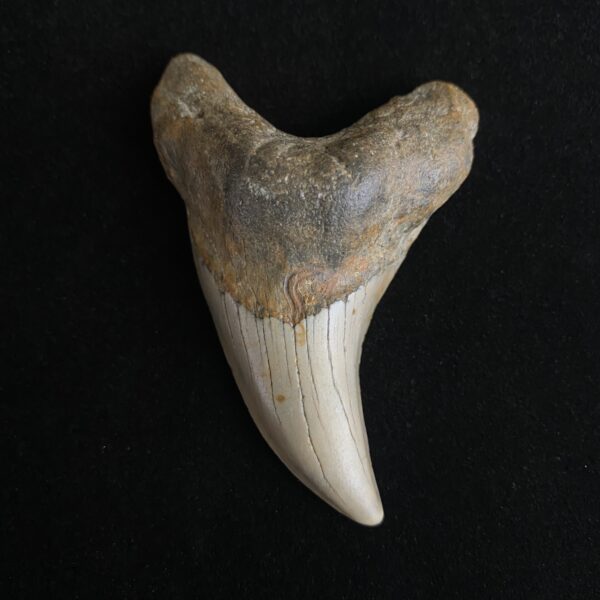
5. Megalodon Tooth Anatomy: Tooth Shape and Jaw Position
Not every Megalodon tooth has the same shape. One of the most educational aspects of
Megalodon tooth anatomy is understanding how tooth morphology changes
depending on its position within the jaw.
Teeth toward the front of the mouth generally served different mechanical roles from
those positioned farther toward the sides and rear. As a result, crown orientation,
width, curvature, and root proportions can vary.
Anterior Megalodon Teeth
Anterior teeth are located toward the front of the jaw. They are often relatively
symmetrical and can possess tall crowns suited to engaging prey.
Lateral Megalodon Teeth
Lateral teeth occur farther along the jaw and frequently show increased asymmetry or
different crown angles. Their shapes reflect their position within the curved dental
arcade.
Posterior Megalodon Teeth
Posterior teeth tend to be smaller and differently proportioned than the enormous teeth
that attract the most attention from collectors.
These variations demonstrate why tooth size alone cannot describe the complete
Megalodon tooth anatomy. Position within the jaw must also be considered.
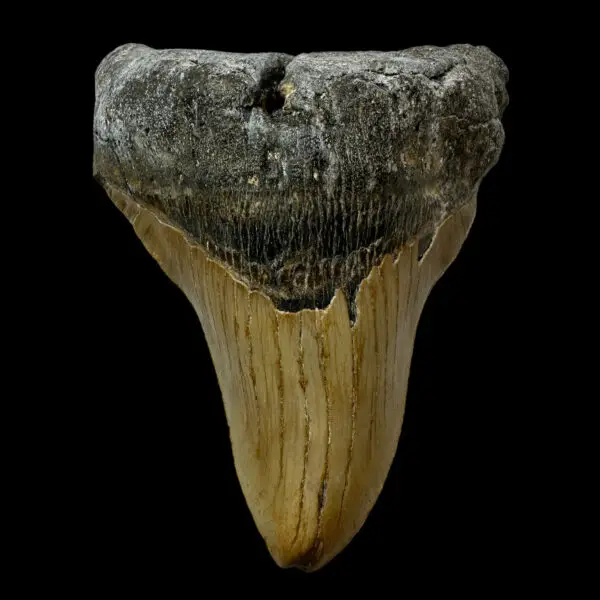
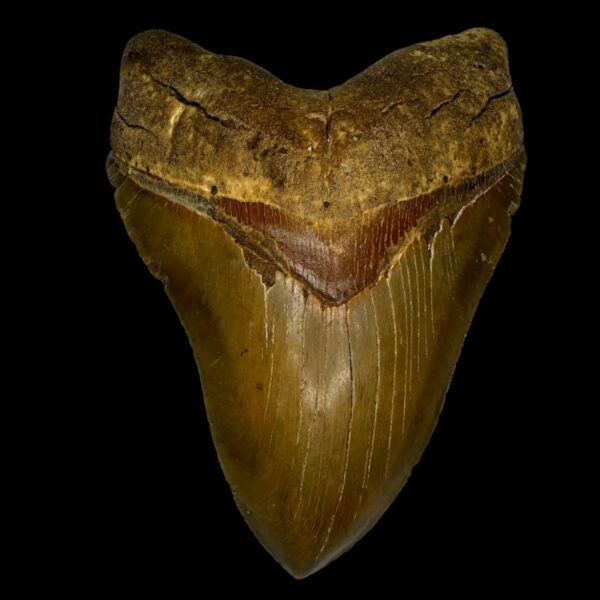
6. Megalodon Tooth Anatomy: Enamel and Fossil Coloration
The enamel-like outer surface of the crown is another striking feature of
Megalodon tooth anatomy. Its durable structure contributes to the
excellent preservation seen in many fossil shark teeth.
Megalodon teeth can display a remarkable range of colors, including black, gray, brown,
tan, blue-gray, reddish, and mixed mineral patterns.
These colors do not represent the original appearance of the living shark’s teeth.
Instead, fossil coloration develops through interactions between the tooth and minerals
present in the surrounding sediment during fossilization.
Does Color Determine the Age of a Megalodon Tooth?
Color alone cannot reliably determine the age of a fossil tooth. Two teeth from similar
geological periods may develop very different colors when buried in sediments with
different mineral compositions.
Likewise, an unusual color does not automatically indicate greater scientific rarity.
Collectors should evaluate coloration together with provenance, preservation, size,
anatomy, and overall condition.
Unveiling Natural Mineral Patterns
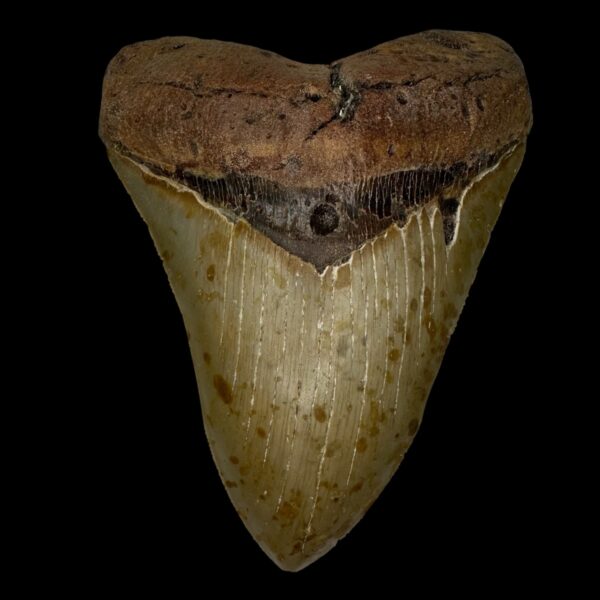
Natural mineralization can create attractive gradients, bands, spots, and contrasting
tones across the crown and root. These patterns make individual fossil teeth visually
distinctive while also reflecting their burial environments.
7. Megalodon Tooth Anatomy: Size and Functional Adaptation
Size is perhaps the most famous characteristic associated with
Megalodon tooth anatomy. Some specimens exceed six inches when measured
along the commonly used longest diagonal dimension.
Large teeth provide evidence of the enormous scale achieved by this prehistoric shark,
but interpreting tooth size requires caution. Teeth from different positions within the
same jaw naturally vary in dimensions.
Therefore, a single tooth cannot provide a perfectly exact measurement of the shark’s
total body length without additional assumptions.
Why Large Megalodon Teeth Are Uncommon
Several conditions must align for an exceptionally large tooth to reach the fossil
market in excellent condition. The original shark had to produce a large tooth, the
tooth had to become buried in suitable sediment, survive fossilization, avoid severe
geological damage, and eventually be discovered.
This combination helps explain why very large specimens with strong roots, intact tips,
natural enamel, and preserved serrations are especially desirable among collectors.
What Tooth Size Can Teach Scientists
Measurements from multiple fossil teeth can help researchers study variation among
individuals, jaw positions, populations, and evolutionary lineages.
Rather than treating size as the only important characteristic, scientists interpret it
alongside the complete Megalodon tooth anatomy.
Megalodon Tooth Anatomy and the Shark’s Feeding Strategy
When all anatomical features are considered together, Megalodon teeth reveal a predator
highly adapted to consuming substantial marine prey. Broad crowns, strong roots, and
serrated cutting edges created a dental system capable of engaging large animals.
The arrangement of different tooth shapes throughout the jaw likely distributed
functions across the mouth. Front teeth could engage prey while lateral teeth provided
additional cutting surfaces.
Studying Megalodon tooth anatomy alongside fossil marine mammal remains
helps paleontologists reconstruct predator-prey relationships in ancient oceans.
Evidence preserved in fossils can include tooth marks on bones and patterns of damage
consistent with attacks or scavenging. Researchers interpret these traces cautiously,
combining them with geological context and comparative anatomy.
Megalodon Tooth Anatomy Compared with Modern Shark Teeth
Comparing Megalodon tooth anatomy with the teeth of living sharks gives
students a useful way to understand adaptation and evolutionary diversity.
Modern shark species possess teeth specialized for different diets. Some have narrow
teeth designed for gripping fish, while others possess flatter teeth suited to crushing
hard prey. Great white sharks have broad, serrated teeth used for cutting.
Megalodon also possessed broad serrated teeth, but similarities in appearance should
not be interpreted as meaning that Megalodon was simply an oversized modern great white.
Modern research places Megalodon within an extinct lineage separate from the living
great white shark.
These comparisons demonstrate how similar feeding pressures can contribute to comparable
functional features in different evolutionary lineages.
How Collectors Evaluate Megalodon Tooth Anatomy
Collectors examining Megalodon tooth anatomy generally consider several
features rather than focusing exclusively on size.
- Overall tooth dimensions and proportions.
- Crown completeness.
- Natural enamel preservation.
- Tip condition.
- Serration visibility and completeness.
- Root preservation.
- Bourlette condition.
- Natural coloration and mineral patterns.
- Evidence of repair or restoration.
- Provenance and geological origin.
An attractive specimen does not necessarily need to be flawless. Some collectors prefer
teeth with dramatic natural coloration, feeding wear, unusual shapes, or geological
features that make each specimen unique.
The most important principle is transparency. Repairs, restoration, reconstruction, or
other significant modifications should be disclosed so collectors can evaluate the
specimen accurately.
Educational Importance of Megalodon Tooth Anatomy
Megalodon tooth anatomy offers an excellent educational introduction to
paleontology because a single fossil can connect multiple scientific subjects.
Students can examine tooth morphology to learn about anatomy and adaptation. Mineral
coloration introduces geology and chemistry. Fossil age connects the specimen to
geological time, while comparisons with other sharks introduce evolution and ecology.
Megalodon teeth can also demonstrate the limitations of the fossil record. Because shark
skeletons consist largely of cartilage, teeth represent a disproportionately large
portion of the evidence available for studying extinct sharks.
By Unveiling the information preserved in each anatomical feature,
educators can transform an impressive fossil into a practical scientific learning tool.
Frequently Asked Questions About Megalodon Tooth Anatomy
What are the main parts of Megalodon tooth anatomy?
The most recognizable features include the crown, root, cutting edges, serrations, and
bourlette. Shape and proportions also vary according to the tooth’s position within the
jaw.
Why did Megalodon teeth have serrations?
Serrated cutting edges were an adaptation that helped the teeth cut into substantial
prey. Their presence is an important functional characteristic of
Megalodon tooth anatomy.
What is the bourlette on a Megalodon tooth?
The bourlette is the band-like region located between the enamel crown and root. Its
degree of preservation varies among fossil specimens.
Why are Megalodon tooth roots so large?
The broad root formed the base of the tooth and supported it within the shark’s jaw
tissues. Root shape also varies depending on tooth position.
Are all Megalodon teeth the same shape?
No. Teeth from anterior, lateral, and posterior jaw positions display different
proportions, curvature, and size.
Why do Megalodon teeth have different colors?
Fossil coloration primarily reflects minerals present in the sediments surrounding the
tooth during fossilization. Color therefore varies significantly between geological
locations.
Does a larger tooth always mean a larger Megalodon?
Not necessarily. Tooth position influences size, so scientists use measurements and
anatomical context rather than assuming a simple one-to-one relationship between a
single tooth and total body length.
What makes a Megalodon tooth valuable to collectors?
Factors may include size, preservation, serrations, enamel quality, root completeness,
bourlette preservation, coloration, rarity, provenance, and the amount of documented
restoration.
Conclusion: Unveiling the Fascinating Science of Megalodon Tooth Anatomy
Unveiling Megalodon tooth anatomy reveals why these fossils are much
more than impressive collectibles. Every crown, root, serration, bourlette, mineral
pattern, and variation in shape preserves information about an extinct predator that
once occupied ancient marine ecosystems.
The seven anatomical features explored in this guide demonstrate how paleontologists can
extract scientific information from fossil teeth even when complete shark skeletons are
rare. Together, these characteristics provide clues about feeding adaptations, dental
arrangement, fossilization, evolutionary history, and the enormous scale of Megalodon.
For collectors, understanding Megalodon tooth anatomy also creates a
better foundation for evaluating specimens. Size may immediately attract attention, but
preservation, serrations, roots, enamel, provenance, and natural geological features
often tell a much richer story.
At The Fossil Exchange, authentic Megalodon teeth provide a direct connection with this
extraordinary chapter of prehistoric marine history. Learning to interpret their anatomy
turns every specimen into an opportunity to explore paleontology, geology, evolution,
and the ancient oceans Megalodon once inhabited.